I began a tulip photography book last year for a Camera Club project, never imagining that returning to it now would become an invitation to begin again.
Nothing Beautiful Is Ever Wasted
Last year, for a Lumen Camera Club project, I made a photograpghic book called The Poetry of Tulips. It arrived the way certain things do — uninvited, unchosen, and yet exactly what I needed. Petal by petal, page by page, it gave shape to something I had carried quietly for years: the ache to create, and the quieter longing to let others see what I’d made. My hands trembled a little over that decision. But I wasn’t alone in the trembling — around me were other photographers holding the same fragile nerve, and somehow, in that shared unsteadiness, sharing my work with kindred spirits felt almost gentle. And then, once the book was finished and the ink had settled, I closed its cover, slid it onto a shelf, and let the dust and the days gather quietly around it.
Now I have opened it again — the photographs, the pages, the soft folds of colour and light. Returning to it has reminded me of something I keep needing to relearn: nothing beautiful is ever wasted.
The flower itself feels like a small lesson in unfolding. It does not hurry. It does not explain itself, or apologise for becoming what it is. It simply opens, on its own time, and lets the light decide what to do with it.

Before the book, before the idea of sharing it, there was simply this: a tulip still gathering itself to open. It became the beginning of an unexpected creative journey - one I had not planned, but slowly learned to trust.
A Beginning I Did Not Plan
The book began with no particular subject at all-just an open invitation from the club to create something, with no particular theme handed to me and no brief to follow. The choice was entirely mine, and somehow without much deliberation, the tulips rose up on their own. I did not reason my way into them. They simply became the thing that I wanted to keep looking at morning after morning, until a book’s worth of of looking had gathered almost without my noticing.
I’m still not entirely sure why I chose tulips. They aren’t indigenous to South Africa — I had to order them in, deliberately, which makes the whole thing feel even less like a decision and more like a pull I couldn’t quite explain. But they spoke to me in a way I couldn’t resist. I often don’t fully understand why I photograph something. It’s rarely about the flower itself. It’s more that a subject seems to be waiting for a voice, and something in me simply answers.
Sometimes creative courage doesn’t look like boldness at all. It looks like following one small, unplanned pull — velvet petals, rain caught like tiny glass beads, a shadow deep enough to hold a secret — and trusting it far enough to see where it leads. That’s really all The Poetry of Tulips ever was: not a bold declaration, but a quiet act of following. And perhaps that’s the same courage I’m circling back to now, taking the book down off its shelf.

Bowed low, almost private in its stillness, this tulip seems to carry its own quiet glow — as if the darkness around it wasn't absence at all, but a kind of shelter. Some things don't stop becoming just because no one is watching. They simply wait, folded inward, until it's time to be seen again.
Returning to What Was Waiting
The truth is, the tulips weren’t really where this began again. It began with prayers — small ones, written in the quiet hours before the house woke up, paired with a photograph and posted more for my own heart than anyone else’s. But my daughter kept telling me how much they meant to her. How one honest image and a few plain-spoken words could reach a part of her day that nothing else touched.
So when I started gathering those prayers and photographs into something that might last longer than a scroll — something with weight, something that could be held rather than swiped past — I went looking through my own archive for images that could carry them. And there it was: The Poetry of Tulips*, already made, already edited, already waiting on a shelf like something left on for me. I hadn’t set out to return to it. It was simply there, as though some earlier version of myself had quietly prepared it for a use I hadn’t yet imagined.
There is a particular tenderness in meeting work you made before you knew what it might become. I could see the woman who made those pages — trying, learning, arranging photographs and words, trusting instinct one small, uncertain step at a time. The photographs had been waiting quietly in the dark of a hard drive, patient as bulbs beneath soil. They had not become less beautiful because time had passed. If anything, the waiting had only settled them, the way light settles on a petal just before it opens.
The original book was large, and lovely, and a little too costly for the pocketbooks of the people I actually want to reach. So I am reshaping it now — a smaller 7×7 hardcover, and an even more affordable 5×5 softcover — something someone could hold in one hand on an ordinary hard day, not just display on a table. Something small enough to fit into a pocket, a bag, a bedside drawer. Something meant to be touched, not just seen.
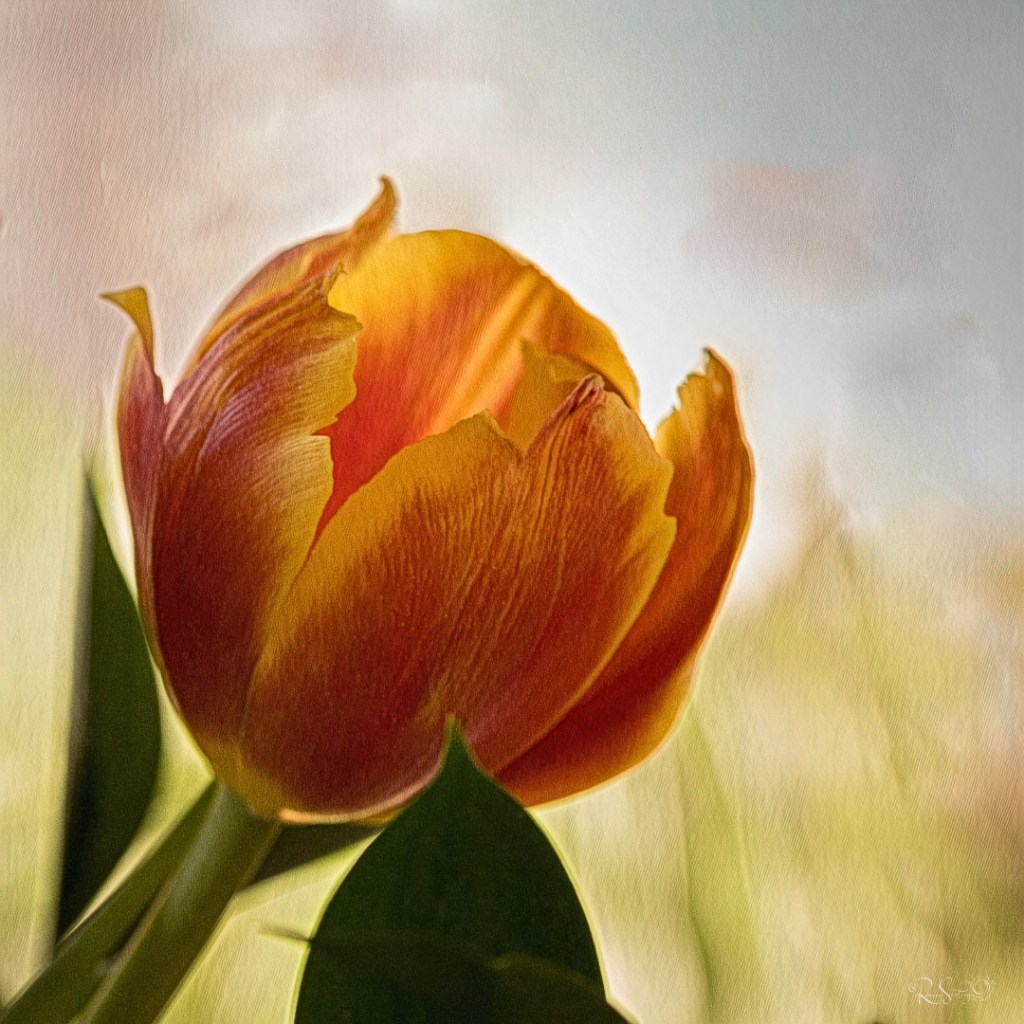
The sun moves straight through this one, turning every vein and imperfection into something luminous. A few petals have frayed at the tips, small tears earned by wind or weather, but they don't hold it back. If anything, they let more light in. Not every opening is soft or unmarked — some are burned a little at the edges, and still, somehow, glow.
The Courage to Let a Book Leave Home
Creating something in private is one kind of bravery. Offering it to the world is another — heavier, it asks more of me, and it doesn’t let go easily.
There is always the small tremor of wondering whether the work is good enough — whether I’ll spend all this, the long days bent over layout and light, choosing which photograph belongs beside which prayer, and still fall short of finding it an audience. Whether my hands simply won’t be steady enough at marketing it, quick enough, loud enough, for it to ever reach the hands it was made for. That fear is quieter than the fear of judgment. It doesn’t announce itself. It just sits there, low and persistent, and it’s the one that keeps me up long after the house has gone dark.
Still, beauty cannot comfort, or encourage, or find its way into someone else’s hands while it stays folded shut in a drawer, buried in a folder no one opens. I am learning, slowly, the way a bulb learns spring, that being seen is not the same as being judged. Sometimes it is simply an offering, held out palm-up: this moved me; perhaps it may move you too.
And so I am trying to let go of the rest — the timing, the reach, the who and the how many. This was never really mine to hoard or protect. If a photograph and a prayer can carry even a small measure of God’s love into a hard morning I will never witness, then my part was only ever to be the vessel, not the source. I did the making. Where it lands, and whose hands it finds, and what it does once it gets there — that belongs to Him. I am simply asked to be a conduit, a narrow channel love can move through, and to trust that He will carry it further than I ever could on my own. That, too, is a kind of creative courage — not the loud kind, not the kind that announces itself with trumpets. Just the quiet kind that keeps showing up, does the work, and then opens its hands and lets it flow.
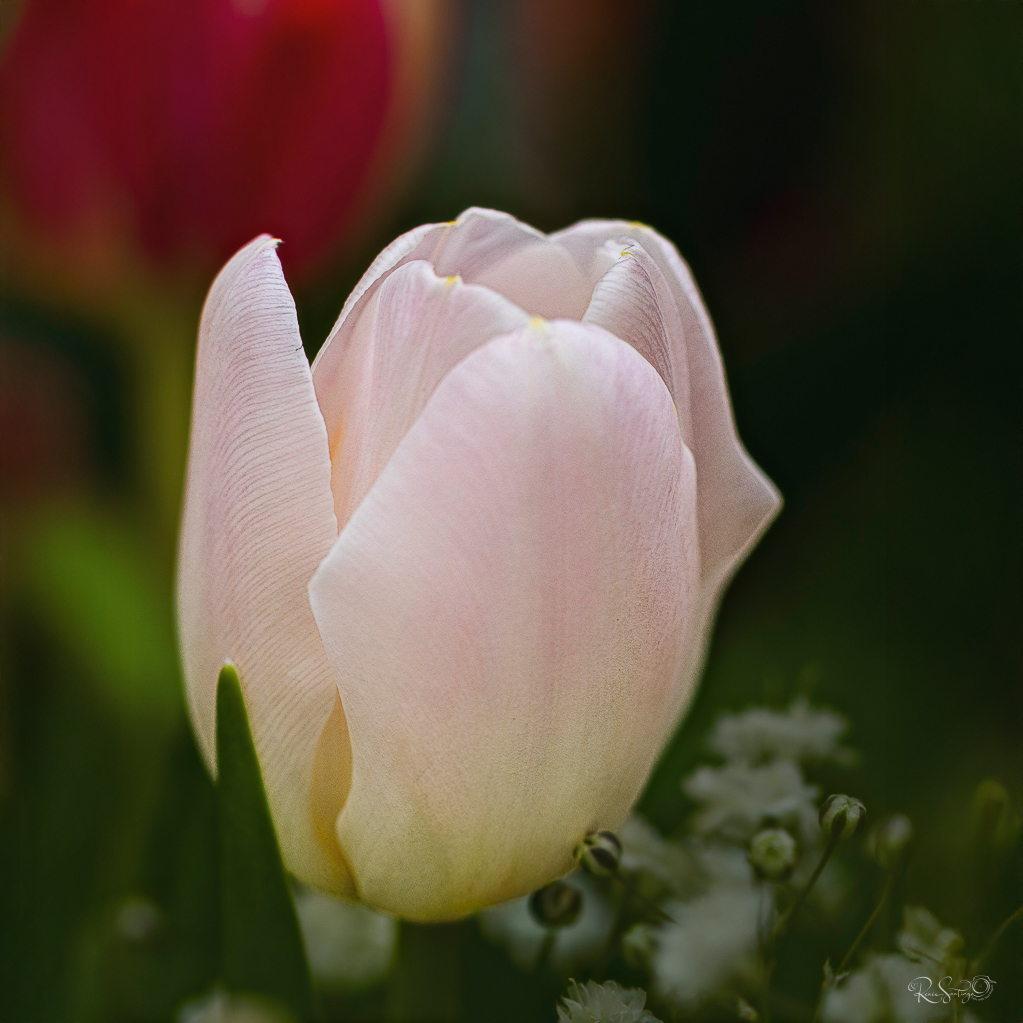
Pale as a held breath, this one leans slightly forward — offered, almost, rather than merely grown. Small white blossoms gather quietly at its feet, as if in support, while a deeper red tulip blurs into the background, its own moment already passed. Beauty like this was never meant to end in a single glance. It waits to be carried further — into a photograph, a page, a prayer, a pair of hands it will never see.
Beauty That Becomes Something More
For many years, my daughter Noemi has lived with the knowledge that cancer may return. She carries a BRCA gene mutation, and she has watched cancer move through her father’s family, taking its toll in ways that don’t stay theoretical for long. She has already walked through two rounds of chemotherapy — the fatigue, the losses, the waiting rooms — and she has been told that treatment may buy her seasons of quiet, but not the certainty of a final goodbye.
It is a hard kind of knowing to carry: not only the illness itself, but the waiting between scans, the slow work of healing, the hope you learn to hold loosely, and the daily task of returning to ordinary life between one difficult chapter and the next.
I have not always been able to give her what I wished I could — not in the ways the world usually measures support: not the cure, not the certainty, not the ability to carry the weight for her. This book is one small way of trying anyway. Not a grand gesture. Something steadier and quieter: a living legacy, a small current of love still reaching toward her, even on the days I cannot be there myself.
Part of the hope behind these smaller, more affordable editions is that they might become something practical — something a stranger could hold in a waiting room, or on a hard morning, and feel a little less alone. And that what I create in that ordinary act of making might, in some small way, also become part of supporting Noemi’s own journey.
This is not about pity. It is about letting the work I love become one small, beautiful expression of care — a living thread stitched between creativity, family, and hope.

This is not a flower caught mid-collapse — it is a flower that finished the work it came to do. Every curled petal carries the memory of having fully opened, fully given, fully lived. Nothing here looks like failure. It looks like completion. Perhaps this is the truest ending this book could hold: not a bloom cut short, but one that gave everything to the light it was given, all the way to its last breath of colour — and wasted none of it.
Nothing Beautiful Is Ever Wasted
The tulips have already taught me this once, and I suspect they will keep teaching me for as long as I photograph them: nothing given fully to the light is ever wasted—not the bloom, not the fading, not even the years a piece of work spends quietly waiting on a shelf.
The Poetry of Tulips is still becoming what it is meant to be. The smaller hardcover and softcover editions are now being resized, reworked, and prepared with care, so that when they are ready, they can travel a little farther and arrive gently in the hands meant to hold them. There is no set date yet. Some things, like flowers, open in their own time—not mine.
Until then, I will keep sharing pieces of this journey here: the prayers, the photographs, the slow and tender work of allowing something private to become an offering. If it has met you today, wherever you are in your own season, I hope it leaves you with what it keeps giving me:
Nothing beautiful is ever wasted. Not even the waiting.
I hope this is only a beginning: the first of many small books where my photographs, prayer, and beauty are gathered together, page by page, and offered with love and care. May each one become a gentle blessing—an open hand, a quiet light, a place to rest for a moment.❣️
| The photographs shared in this post are also part of The Poetry of Tulips collection—small glimpses of the pages and petals that will make their way into the book.