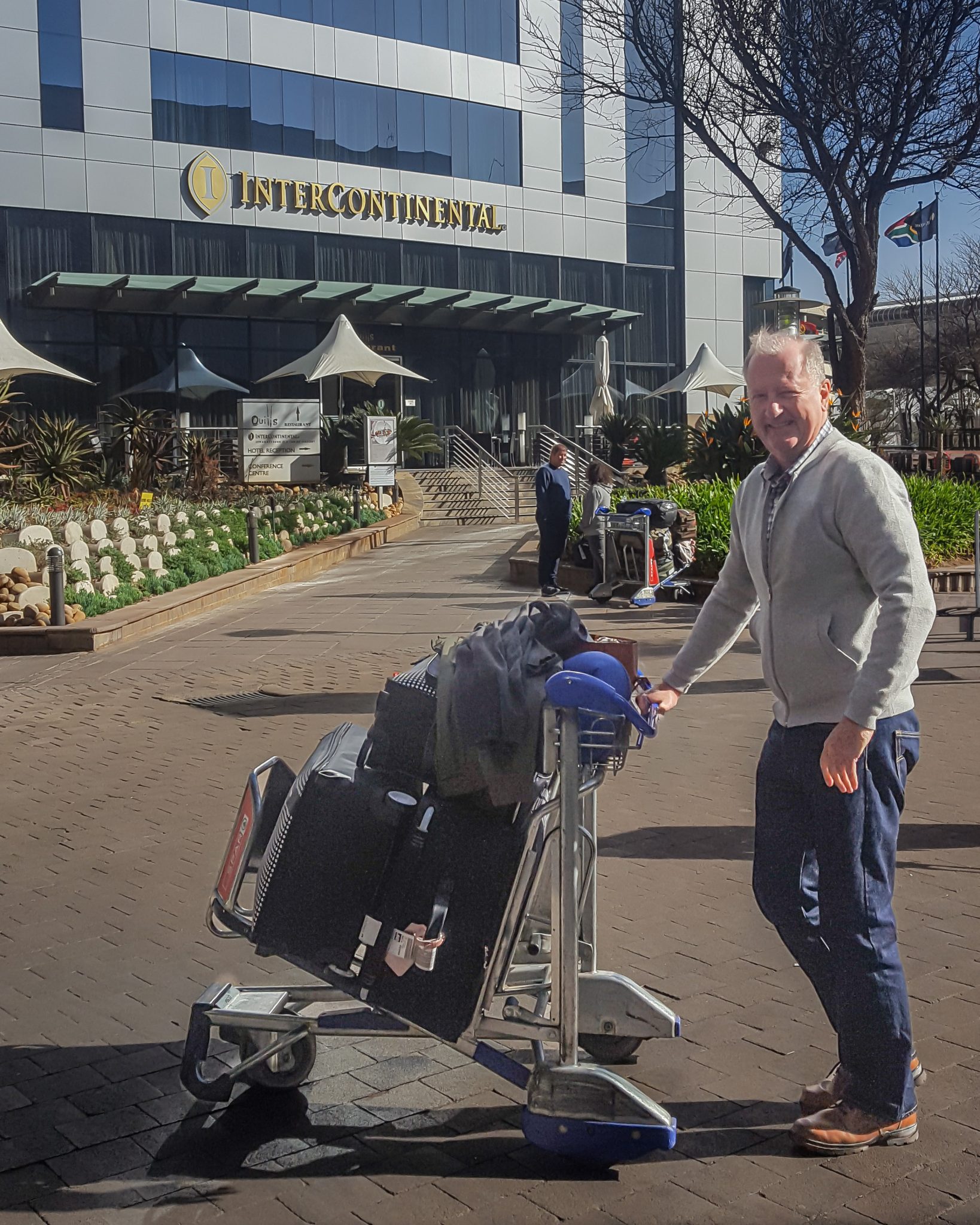
July 19, 2019—Patrick with the three suitcases that held what remained of my old life as I began again in South Africa.
A personal reflection on leaving, belonging, unexpected love and the grace of beginning again.
Seven years ago-already, somehow-I walked through the doors of OR Tambo International Airport dragging three suitcases behind me like reluctant pack mules. Some days that morning is close enough to touch: the recycled airplane air still clinging faintly to my clothes, the squeak of the trolley wheels on the polished tiles, the specific brand of exhaustion that only a long-haul flight can produce, On other days, it belongs to someone else’s lifetime entirely.
Three suitcases. That was the whole of me, zipped shut and-mercifully-under the weight limit.
Everything I owned had been dwindled down into what could be folded, wrapped and squished inside them. Airline baggage limits can be remarkably unsentimental editors, and mine had taken a red pen to a lifetime without so much as an apology. The rest given away, thrown away or left behind: familiar possessions collected over decaded, and the ordinary things that I had held tightly unto throughout a lifetime of moving.
There is something funny-in the worst, most disorienting way-about watching an entire life get reduced to three pieces of luggage and a baggage tag.
The suitcase wheels rattled and stuttered over the hard airport floor, catching on every seam in the tile, while a blur of unfamiliar voices, echoing announcements and hurried footsteps rushing past. Everyone around me seemed to know exactly where they were going, walking with the unbothered confidence of people who had done this a hundred times before. I knew where Patrick was supposed to be. For that one very jet-lagged morning, that had to be enough. I arrived in a new country carrying the few possessions I’d kept-and the considerably heavier weight of everything I’d left behind.
When I look at the photograph now, I see Patrick beside the luggage trolley on that bright African winter morning. I also remember the woman I was then: tired, hopeful, uncertain, and blissfully unaware of just how many suitcases-literal and otherwise-the next seven years would ask her to unpack.
I had just walked through one set of doors, but I did not yet know how long it would take for this new life in South Africa to feel like my own.
Sometimes beginning again means walking through a door with only what you can carry – and trusting that a new life will gradually gather around you.
Leaving One Life for South Africa
Moving to South Africa was not simply a journey from one country to another. It was the closing of one book and an uncertain opening of another.
I had left behind familiar streets, familiar shops and the small routines we rarely notice until they are gone. Even the voices around me sounded different. Afrikaans flowed around me in unfamiliar phrases, while isiXhosa carried its distinctive click consonants—crisp, percussive sounds my tongue had no idea how to imitate.
Even when people spoke English, I often had to ask them to repeat themselves—not once, but several times—because the accents, rhythms and emphasis were so different from those my ears had known. I would smile apologetically and say, “Could you please say that again?” only to discover that repeating the same words at the same speed did not make them any clearer. South Africa seemed to speak in several directions at once, and I quickly learned that knowing English did not always mean I understood the conversation.

The light was different too.
South African sunlight seemed to arrive with the volume turned up — brighter, sharper, more opinionated, throwing hard-edged shadows across everything it touched. The wind came off the sea smelling of salt and something faintly metallic, pressing its whole weight against the doors and rattling the windows like it wanted in on the conversation. And in the mornings, I was jolted awake by the hadedas — (Hah-dee-dah) a call so loud, so prehistoric, that I became fully convinced the dinosaurs had simply relocated to the neighborhood and taken up shrieking as a hobby.
Nothing was automatic yet. Grocery runs required strategy. Roads curved in directions my instincts insisted were wrong. Products wore unfamiliar names, and the simplest conversation could leave me hunting for a word, or quietly wondering whether I’d understood a single thing that had just been said to me.
I noticed everything, because nothing had earned the right to be ordinary yet.
When Patrick's Home Became Our Home
I did not arrive at an empty house waiting to be filled. I arrived at Patrick’s home—a place that already had its own routines, its own preferences and the settled shape of a life he had been living quite well without me. Or so he claimed. His photographs of brown-bread, butter and wiener sandwiches suggested otherwise. He sent them to make me feel sorry for him—a carefully planned culinary cry for help. It worked.
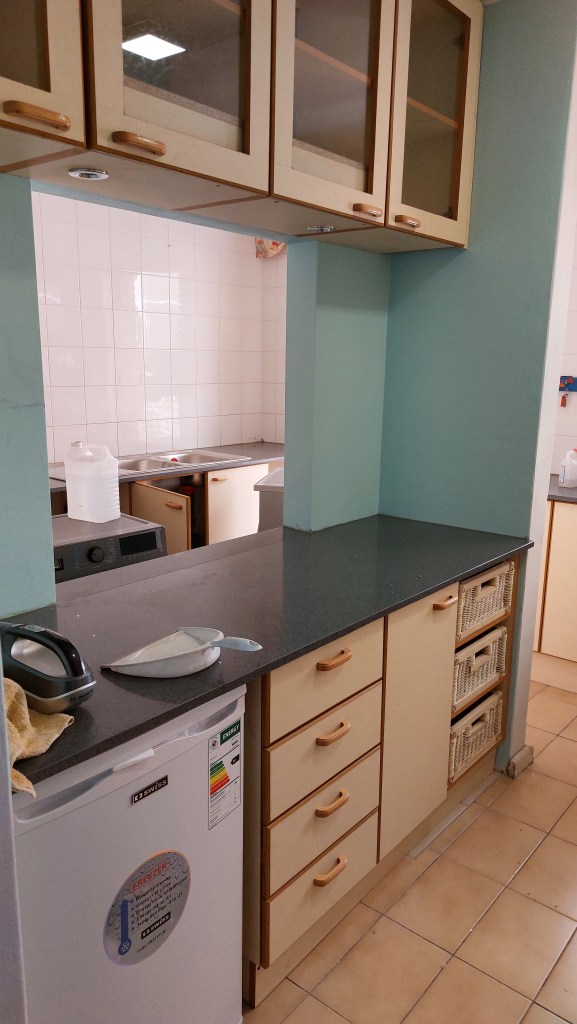
The walls were white — a condition I did not intend to let become permanent. His belongings all had their assigned places, the way objects do in a house that has never had to negotiate with anyone. The kitchen carried the smell of the food he knew and loved, foreign and comforting all at once. At first, I was simply stepping carefully through a life that already existed, trying not to knock anything over.
Gradually, almost without either of us noticing, the house began to change.
The plain white walls took on color, one coat at a time. White walls, I discovered, are really just blank pages with better structural support, and it turned out I had opinions to publish. Paintbrushes moved back and forth, releasing that sharp, clean smell of fresh paint that seems to announce a change of management. The few things I’d smuggled in inside my suitcases found room among Patrick’s belongings. My photographs went up on the walls. Small American touches crept into the rooms — not enough to erase what had been there before, but enough that I could finally recognize myself in the reflection of the place.
The kitchen changed too. Some evenings, onions and peppers hissed and spat in a hot pan, and the warm, smoky scent of fajitas rolled through the house, announcing — loudly, deliciously — that an American had taken up residence, whether or not the paperwork agreed yet. The foods of the life I’d left behind started mixing it up with the flavors of the country I now called home.
Home did not arrive with my three suitcases. It grew slowly, each time something of his and something of mine quietly agreed to become ours.
There was no single day when Patrick’s home suddenly became our home. It happened in a hundred small, unglamorous decisions — a paint color argued over and settled, a spot chosen for a photograph, a dinner built from two different countries’ worth of ingredients.
The house became a kind of ongoing conversation. His history stayed in it, but mine started speaking up too. South Africa was outside the windows, while small traces of America made themselves at home inside. Somewhere between the colored walls, the photographs finding their places, and the smell of fajitas warming the kitchen, his home quietly, stubbornly, became ours.

Seven Years in South Africa: The Wonderful and the Challenging
Outside our door, South Africa was slowly becoming familiar too.
Roads that once needed careful directions turned into routes my hands and feet seemed to remember on their own. I learned the particular sharpness of the Port Elizabeth wind, and the exact angle at which it could rip a car door out of your hand if you weren’t holding on with both.
I got used to days that started cold enough for three layers, warmed under a fierce afternoon sun, and turned cold again before dinner — three seasons auditioning for the same twenty-four hours, sometimes before lunch. The dusty gold of winter grass, the enormous sky, the salt-and-seaweed smell of the ocean — all of it settled into the landscape I now carry around inside me, free of charge.
There has been so much wonder in these seven years. I see this new life as a genuine blessing from God, arriving after a long stretch of years spent alone. Patrick came into my life later than I might once have planned for, but maybe that’s exactly what makes this love feel so precious — it did not have to happen, and it did anyway. He is my hero, my knight in shining armor, though these days his armor looks considerably more like car keys, a steady hand, and a patient smile aimed at whatever I’ve just done to the Wi-Fi router.
Through Patrick, I was also handed a whole new family who accepted me — warts and all, possibly before they’d finished a full inventory of the warts. I found a particularly close friendship with my sister-in-love, my S-I-L, and the gift of belonging somewhere people had already made room for me. After years of feeling like a guest in my own life, that kind of acceptance felt like coming home twice.
Patrick and I have taken trips I once couldn’t have pictured. We’ve driven under enormous skies with the tires humming for hours, watched animals move through winter grass, and stood in cold wind in front of landscapes that still, every time, stop me mid-sentence. Through my camera, I learned to look at South Africa properly — the stillness of an animal holding its ground, the weathered grain of an old door, the click of the shutter, the way late-afternoon light rearranges everything it touches. Every trip with Patrick has become another page in the story we’re apparently still writing.
There have been ordinary pleasures too — coffee cups landing on the same counter every morning, familiar voices in the next room, the fur babies arranging themselves into the rhythm of the house like they own the deed, evenings when the smell of dinner drifted into rooms that finally, unmistakably, felt like ours. None of it looks important from the outside. All of it is exactly what a shared life is built from.
This life has been a wonderful blessing, but it has not been untouched by fear, illness or pain. In 2020, not long after I arrived in South Africa and before Patrick and I were married, he was diagnosed with stage-four cancer. Our new life together suddenly included hospital corridors that all smelled the same, the sharp antiseptic hush of treatment rooms and days arranged entirely around appointments, blood tests and chemotherapy.
Later, when we feared the cancer had returned, the diagnosis turned out to be tuberculosis. The relief of hearing that it was not a recurrence was quickly tempered by six months of medication that proved every bit as difficult as the chemotherapy. My daughter’s cancer journey has brought a different kind of pain and helplessness, made harder by the distance between us and the limits of what can be carried through a telephone screen. Then came my knee replacement and the long, slower-than-promised business of healing. My knee, it turns out, keeps its own calendar—and has very strong opinions about mine.
Yet the wonderful and the difficult were never separate stories. They lived side by side — fear and tenderness, exhaustion and laughter, a hospital appointment followed by another beautiful drive, uncertainty softened by the familiar shape of Patrick beside me. The medical world did its best to fill our calendar. It never once managed to claim the whole story. The hard seasons taught me that home isn’t only the place where life is easy. It’s also the place where you’re loved and held when it isn’t.
Belonging didn’t arrive with a grand announcement. It settled in quietly, one ordinary — and occasionally extraordinary — day at a time. Patrick didn’t rescue me from every hard thing. He did something better: he stayed beside me while we walked through them.


Seven Years, Three Visas and Far Too Many Certified Copies
This week, seven years after arriving at OR Tambo with those three suitcases, I completed and submitted the application for my third two-year spousal visa. Six years of permission to remain have been measured out two years at a time, each renewal requiring another collection of forms, certified copies, photographs and signatures.
Next week, I will take the next step and apply for permanent residency in South Africa.
The approaching residency application has made me look backward as much as forward. Pale winter light stretched across the table where the papers lay in careful piles. Plastic sleeves slid against one another as I checked the list again. The stapler snapped shut, and the faint chemical smell of fresh photocopies lingered in the room.
Certified copies. Bank statements. Photographs. Passports. Affidavits. Signatures. Dates. South Africa does appear to love a certified copy almost as much as I love a colored wall.

Even after checking the list several times, I learned that more documents would be helpful. “Three months of bank statements,” the woman suggested, along with a handwritten affidavit from Patrick saying that he would support me financially, emotionally and physically. Of course, I thought. One more item for the scavenger hunt. I was surprised by how much anxiety the process stirred in me. Logically, I knew that whatever happened, we would find a way through it. Yet logic did not stop my body from tightening as I wondered whether one overlooked page might close a door I had already lived. Patrick steadied me, as he so often has.
The folder had a physical weight when I lifted it, but it also carried the weight of seven years. There is something strange about gathering documents to prove a life you are already living.
A passport can show where I was born. A certificate can record a marriage. A form can list where I have lived and when I arrived. But those papers cannot contain the smell of the sea, the sound of wind against our windows, the rooms we painted or the scent of fajitas rising from the kitchen.
The papers may record when I arrived, but they cannot hold the life I have lived since then.
They cannot record the difficult seasons Patrick and I have walked through together, or the ordinary evenings when nothing remarkable happened—and yet a shared life was being created.
What Seven Years Have Taught Me About Courage
When I arrived in 2019, I may have imagined courage as the decision to leave one country and begin again in another. That was courage, but it was only the first expression of it.
Courage was also learning unfamiliar roads and allowing someone else’s house to become mine. It was loving through illness, remaining present during uncertainty and beginning again after days that left us depleted. More recently, it has meant doing the simple exercises my healing body finds difficult, writing honestly about memories I once kept closed, and gathering another folder of documents even while anxiety sits beside me.
Seven years have taught me that courage does not always feel brave. Sometimes it is quiet and repetitive. It checks the papers once more. It prepares dinner. It paints a wall. It holds a hand in a difficult room. It learns that the hadedas are not announcing the end of the world. It takes one careful step and then another.
Perhaps that is why the photograph of my arrival moves me now. The woman standing just beyond the frame did not know what the next seven years would contain. She only knew that Patrick was waiting and that the life behind her had been reduced to three suitcases. She could not see the whole journey. She simply walked forward into it.
Courage is not knowing exactly what waits on the other side of the door—and choosing to step through it anyway.
Seven Years, Three Visas and Far Too Many Certified Copies
When I arrived in 2019, I probably thought courage meant the decision to leave one country and start again in another. That was courage — but it turned out to be only its opening line.
Courage was also learning unfamiliar roads and letting someone else’s house slowly become mine. It was loving someone through illness, staying present through uncertainty, and starting again after days that left us both wrung out. More recently, it’s meant doing the small, unglamorous exercises my healing body finds genuinely difficult, writing honestly about memories I used to keep the door shut on, and assembling yet another folder of paperwork while anxiety sits in the chair next to me, uninvited.
Seven years have taught me that courage doesn’t always feel brave. Sometimes it’s quiet and repetitive. It checks the paperwork one more time. It makes dinner. It paints a wall. It holds a hand in a hard room. It learns, eventually, that the hadedas are not, in fact, announcing the end of the world. It takes one careful step, and then another.
Maybe that’s why the photograph from my arrival still moves me. The woman standing just outside the frame had no idea what the next seven years would hold. She only knew Patrick was waiting, and that the life behind her had been reduced to three suitcases. She couldn’t see the whole road ahead. She just walked forward into it, wheels rattling.
The Life I Call Home Now
Seven years ago, I arrived in South Africa with three suitcases containing nearly everything I still possessed. Today, the life I have gathered around me could never be packed into luggage.
It lives in colored walls and photographs, familiar roads and coffee cups, the smell of fajitas drifting through the kitchen and the unmistakable announcement of the hadedas each morning. It lives in family gatherings, laughter, long drives beneath enormous skies and thousands of photographs taken during excursions with my favorite traveling companion.
Somewhere along the way, South Africa stopped being simply the country I had moved to and became the place where my life was happening.
God did not give me a life without hardship. There was cancer, tuberculosis, months of difficult medication, my daughter’s cancer journey and a knee that continues to insist it has never seen my recovery schedule. But God also gave me Patrick—the man who remained beside me through all of it. He gave me a new family who accepted me, warts and all, and a sister-in-love whose friendship has become one of the special gifts of these years.
After so many years of feeling alone, I have companionship, family and a home filled with the evidence of two lives joined together. Patrick is my hero, my rather practically armored knight and the love of my life.
Seven years ago, I could not see the life waiting ahead of me. Looking back now, I can see how love, hardship, laughter, faith and grace have all traveled together.

Sometimes the best does not arrive first. Sometimes it takes the scenic route.
And sometimes, by grace, the best is last.
With light, laughter, and a touch of magic, may your heart find peace, your dreams find wings, and your days be filled with love and joy.
Sending hope from my heart to yours. ❣️